
PSL, looksmaxxing, and Omoggle scores explained
Separate Omoggle-style scan feedback, PSL score language, looksmaxxing inputs, mogging comparisons, and retake confidence.
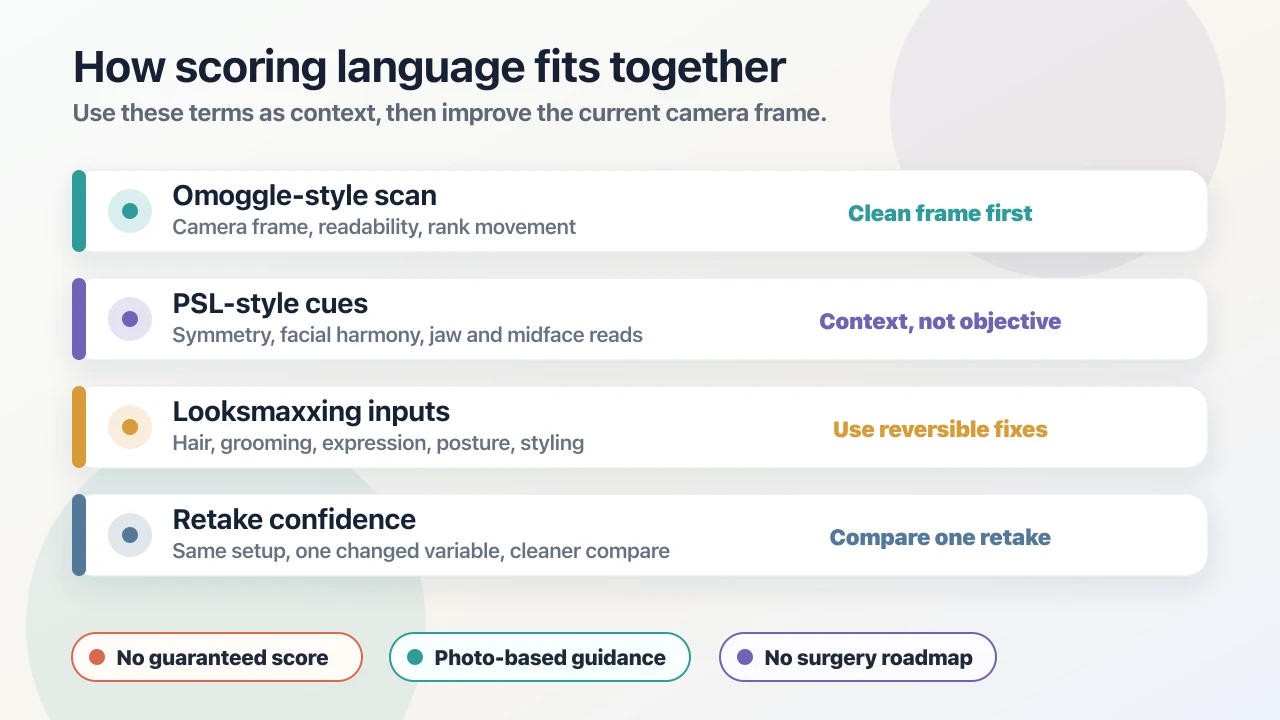
TL;DR
The shortest version before the full guide.
- Treat Omoggle-style scores as camera-frame feedback, not as a fixed truth about a person.
- PSL score language is internet appearance-rating shorthand, not an objective, medical, or permanent label.
- Looksmaxxing inputs are mostly reversible presentation variables: photo setup, hair, grooming, expression, posture, and styling.
- Mogging language is comparative, so it can become noisy or harsh when the photo context is uncontrolled.
- Retake confidence helps you decide whether a score change is probably about the setup or just photo noise.
Quick glossary of score terms
The same discussion can mention Omoggle, PSL, mogging, looksmaxxing, face rating, and score confidence. These ideas are related, but they do not mean the same thing. Separate them first, and the next action gets clearer.
| Term | What it usually refers to | What it does not prove | How to use it constructively |
|---|---|---|---|
| Omoggle-style score | A score or rank from a camera-based scan or interaction. | It cannot reveal permanent attractiveness truth or exact model weights. | Improve lighting, lens height, framing, clarity, and retake consistency first. |
| PSL score | Internet appearance-rating shorthand for facial harmony, symmetry, jawline, midface, skin, and feature balance. | Do not treat it as objective science, a medical read, or a reliable label for self-worth. | Use it only to name broad visual cues after you have a clear source photo. |
| Looksmaxxing inputs | Reversible presentation variables such as hairstyle, grooming, skin appearance, expression, posture, styling, and photo setup. | They do not prove that a person has changed permanently. | Change one variable at a time so you can see what actually improves the next frame. |
| Mogging or mogged | Comparison language about someone appearing stronger in a specific photo or social context. | It falls apart without similar lighting, angle, lens distance, and crop. | Compare your current photo to your previous setup, not to random strangers. |
| AI face rating | A structured read of the visible photo, often including score, dimensions, and improvement priorities. | Do not use it as a medical, surgical, identity-based, or final judgment. | Use it to choose the next controllable retake or presentation step. |
| Retake confidence | How comparable the next scan is to the previous one. | It says whether the comparison is clean, not whether you are better or worse. | Keep expression, crop, distance, and setup stable while changing one variable. |
Omoggle-style score: treat it as scan feedback
Read an Omoggle-style score as feedback from a camera-based experience. The visible input is the frame: light, lens height, distance, crop, motion blur, compression, expression, and face visibility.
A noisy frame can make the score feel more dramatic than it is. A low laptop camera can exaggerate the lower face. Backlight can hide the eyes and jaw edge. A tight selfie can distort proportions. A cropped forehead or chin can remove useful context from the scan.
- Check whether the face is front-lit.
- Check whether the lens is near eye level.
- Check whether the forehead, chin, both eyes, and both sides of the face are visible.
- Check whether blur, compression, or lag changed the frame.
- Retake one setup variable before interpreting deeper cues.
PSL score: shorthand, not objective truth
PSL score language is common in online appearance-rating discussions. It often points to broad visual cues such as facial harmony, symmetry, jawline, midface, skin, feature balance, and overall presentation.
The useful part is vocabulary: it can help name what people are reacting to in a photo. The risky part is overclaiming. A single frame cannot objectively measure a person, and PSL-style language can become harsh, pseudo-scientific, or self-critical when people treat it as a permanent label.
Looksmaxxing inputs: practical presentation variables
Looksmaxxing is most useful when it means reversible, non-medical presentation work. In a photo-based score context, the strongest inputs are usually simple: camera setup, hair control, grooming edges, skin shine, expression, posture, clothing contrast, and background clarity.
These inputs do not change the person underneath the photo. They change how readable and polished the current frame is. Keep the order simple: first light and camera, then presentation.
- Move hair away from eyes, forehead, and jawline.
- Clean grooming edges before retaking.
- Reduce face shine or harsh shadow if it distracts from the frame.
- Use a relaxed expression instead of forced intensity.
- Keep posture upright but natural.
- Choose background and clothing contrast that keeps the face readable.
Mogging and comparison language
Mogging and "getting mogged" are comparison terms. They usually describe a situation where one person appears more dominant, polished, photogenic, or visually strong than another in a specific context.
Comparison language is noisy because photos are rarely controlled. One person may have front lighting, a longer lens distance, and a cleaner crop, while another has backlight, a low angle, and motion blur. That is not a meaningful comparison.
For improvement work, compare against your own previous setup. To understand the slang more fully, read What Does Get Mogged Mean?.
Why scores move between photos
Scores can move because the person changed, but they can also move because the input changed. In most quick retake loops, input changes are the first explanation to check.
| Score movement | Common photo reason | Better next check |
|---|---|---|
| Score drops after a retake | Darker room, lower lens, tighter crop, new blur, or harsher expression. | Match the previous setup, then change only one variable. |
| Score rises after a retake | Cleaner front lighting, eye-level camera, full-face framing, or better image clarity. | Repeat the same setup once to see whether the gain is stable. |
| Score jumps around | Too many variables changed at once. | Create one baseline and follow a controlled retake order. |
| Score conflicts with how the photo feels | The frame may hide or exaggerate cues that people read differently. | Use the score as one signal, then inspect lighting, crop, and expression. |
How to read a score safely
Begin with the least emotional layer: photo quality. If the frame is dark, low, cropped, or blurry, skip the deep interpretation and make a cleaner retake.
Then read the AI Face Rating result as a current-photo read. Ask what the current frame makes visible and what it hides. After that, use PSL-style cues and looksmaxxing inputs only to choose the next reversible step.
- Fix scan quality: front lighting, camera height, distance, crop, and clarity.
- Check retake confidence: one changed variable per retake.
- Name broad cues: symmetry, face shape, grooming, expression, and presentation.
- Choose one practical next step.
- Avoid permanent conclusions from one score.
What to ignore
Ignore fake camera feeds, face-warp filters, APKs, extensions, and tools that claim to manipulate scan outputs. They create platform and safety risks, and they make the score less useful as feedback about a real current photo.
Also ignore any advice that turns a score into a medical claim, surgery roadmap, identity guess, humiliating ranking, or objective attractiveness label. Constructive score work should stay photo-based, reversible where possible, and focused on the next useful frame.
Where to go next
If your goal is a better Omoggle-style scan, use the practical retake guide: How to Improve Omoggle Score.
If your goal is a cleaner upload for MogScore, start with Best Photo for AI Face Rating or run the free preview on Mog Rating.
Frequently Asked Questions About PSL, Looksmaxxing, and Omoggle Scores Explained
Short answers to the search questions this guide is designed to resolve.
Use the guide with a current-photo preview
Start with one clear photo, then use the guide to decide which setup or style change to test next.
Related articles
Continue with the next setup, glossary, or product guide.
 How-toHow to Improve Omoggle Score Before Your Next ScanFix controllable Omoggle-style score leaks first: front lighting, eye-level camera height, full-face framing, image clarity, and repeatable retakes.
 ExplainerWhat Does Get Mogged Mean?To get mogged means to be outclassed or outshined in a comparison, usually around appearance. The definition comes from internet slang sources, not from MogScore product language.
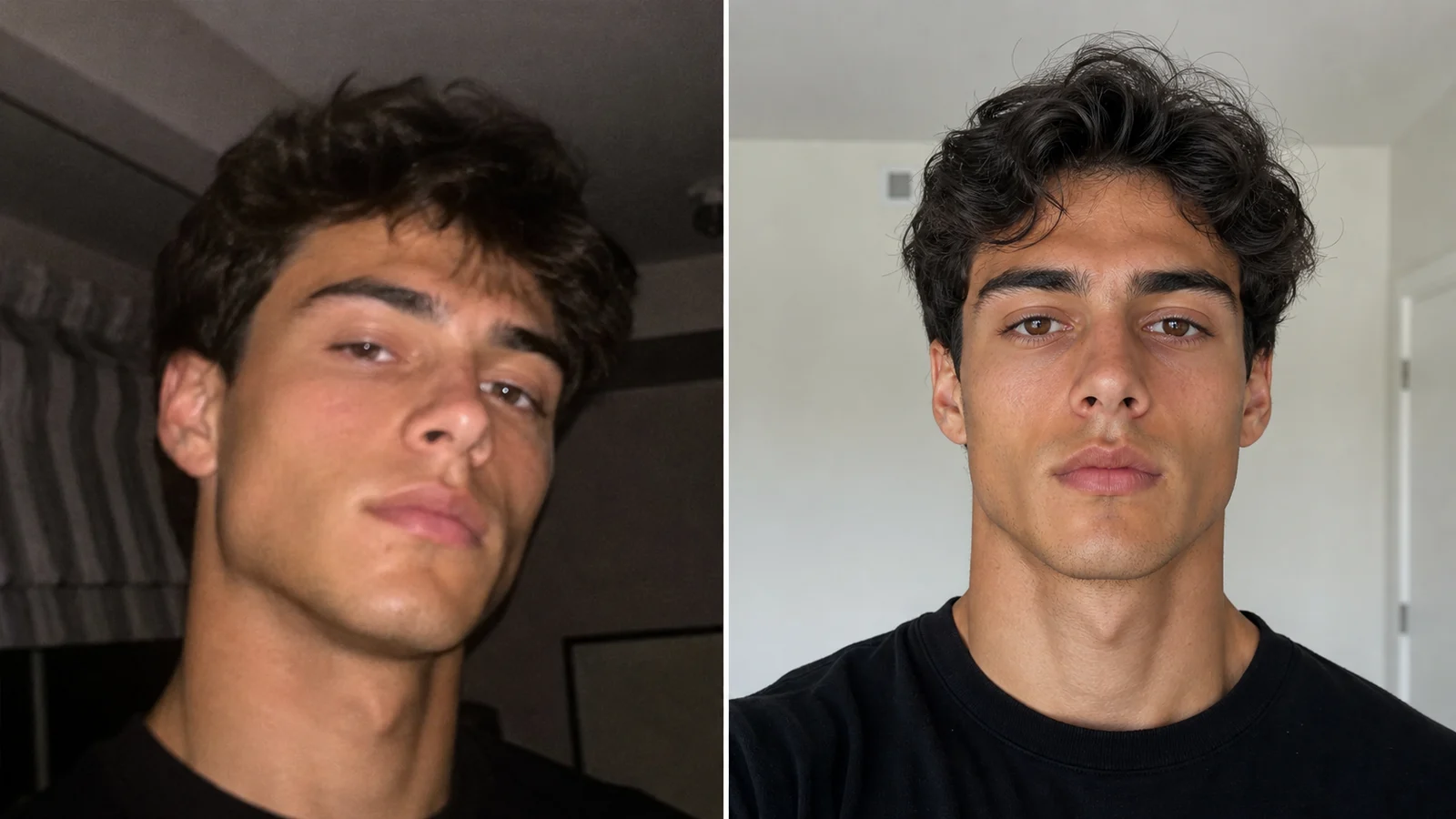 Photo TipsBest Photo for an AI Face RatingPick a cleaner photo for your MogScore AI Face Rating by checking light, crop, blur, distance, filters, and retake priority before upload.