
Looksmaxxing Slang: Context, Uncertain Acronyms, and Harmful Labels
A contextual reading guide for ambiguous acronyms, ordinary phrases, and loaded labels that do not belong in a face-rating scale.
TL;DR
The shortest version before the full guide.
- A caption can be a joke, an ordinary phrase, or community-specific jargon.
- 333, CTN, TLPUR, and lookspill need context; do not invent a fixed meaning.
- Despair-related and racialized labels should not become appearance categories.
- A useful follow-up asks for the intended meaning, source, and actual decision.
Read the sentence before the acronym
Use this guide to decide what a caption is doing and how to respond. Some terms are ordinary phrases; some are uncertain acronyms; others carry harmful framing. Similar-looking letters do not make them parts of one rating scale.
Read the complete sentence, including the question it answers. Then ask whether the writer is describing a visible feature, expressing a mood, or making a joke, and which source supports the proposed expansion. A screenshot repeated across accounts can spread a claim without independently verifying it.
The examples here are editorial explanations, not quotations from customers. Community sources are used to document language and disagreement, rather than validate claims about bodies, health, or social outcomes.
333
The number 333 appears in some looksmaxxing and “IQmaxxing” conversations, but a number alone does not establish a fixed expansion. A community thread asking what 333 means illustrates uncertainty around the term. That supports treating it as ambiguous in that context, rather than adopting a particular explanation as fact.
Do not infer that it is a scientifically defined angle, ratio, intelligence measure, or health practice. Ask the poster what they mean, then evaluate that specific claim separately. Repetition of the number is not evidence for the claim.
CTN
The sources reviewed for this guide do not establish CTN as a stable attractiveness tier. Treat the letters as unresolved until the writer supplies a definition and context.
If a post uses CTN, obtain its own definition and scale before comparing it with HTN. Similar-looking initials do not establish equivalent categories. Do not invent a middle tier merely to complete a chart.
TLPUR
A discussion asking for TLPUR’s meaning contains competing expansions, including “too late puberty” and “true larper per unit ratio.” It does not establish an authoritative origin or a medical meaning.
If the surrounding claim concerns growth or puberty, do not treat an acronym as a health assessment. The meaning intended by a poster and the truth of their claim are separate questions. This guide does not supply a treatment, deadline, or growth prediction.
DWBI
In casual texting, DWBI can mean “don’t worry ’bout it,” as documented by Cyber Definitions. Its conversational role can be reassurance or dismissal, depending on the surrounding exchange. It does not describe a facial feature or a rating scale.
An unexplained “DWBI” after a serious question leaves the question unanswered. Ask for the actual observation or decision. There is no useful conversion from this response into a photo score.
Lookspill
The sources reviewed for this guide do not establish a fixed definition of lookspill. Do not assume a word resembling “looks” and “pill” names a validated psychological effect.
Check whether the original post contains a typo, a local joke, or its own explanation. If the writer means an overall impression influencing judgments, halo explains that separate concept with a primary historical source. The spelling alone cannot prove that connection.
Never stress
“Never stress” is an ordinary phrase and may function as a meme caption or reassurance. It is not a technical term with a universal looksmaxxing definition. Read what the speaker is responding to: a minor retake problem and sustained distress need different responses.
For a photo problem, specify the next check instead of promising that nothing can go wrong. For a serious personal concern, a slogan does not replace a supportive conversation or appropriate help.
LDAR
In some hostile or defeatist online discussions, LDAR is shorthand for “lie down and rot.” Tim Squirrell’s 2018 field glossary documents this usage, along with rope and Tyrone below. It is historical evidence of the vocabulary, not proof that every contemporary caption uses it the same way. LDAR expresses withdrawal or resignation rather than a photo observation; it should not be adopted as advice.
Do not convert the phrase into a recommendation to isolate yourself or a verdict about someone’s future. If someone uses it about themselves, respond to the distress rather than offering another rating or a supposed tier correction.
Rope
The ordinary word can be used as a self-harm allusion in harmful appearance discussions. Context matters, and not every use of the literal word has that meaning. This guide gives no method or instruction.
If a message indicates immediate danger, seek local emergency help. In the United States and its territories, the 988 Lifeline offers crisis support; outside that area, use the appropriate local service. An appearance label or a face-analysis tool is not the right response to a crisis.
Tyrone
Tyrone is a personal name. In some appearance-community memes it is also used as a racialized male archetype. The stereotype should not be confused with a real person’s identity, personality, or prospects.
Do not infer someone’s race or categorize their face from the meme label. For styling feedback, describe the actual hair, clothes, light, or framing without a racialized comparison. Naming a stereotype for critical discussion does not make it a legitimate rating category.
Three example replies you can adapt
These are language examples written for this guide, not actual user conversations.
- Unclear expansion: after “That is CTN,” ask “What does CTN mean in this post, and which scale are you using?” Do not assign an expansion before the writer answers.
- Dismissive reply: after “DWBI” to a hair-framing question, ask “Do you mean either style is fine, or that you cannot tell from this photo?” The follow-up distinguishes reassurance from missing information.
- Unhelpful slogan: after “Never stress” about a blurry image, say “I will retake it with a steady camera; then I can compare.” This turns a minor capture issue into a concrete next step.
These templates are for ordinary language clarification. If the message concerns distress or immediate danger, respond to that situation instead of treating it as a slang puzzle.
Turn jargon into a useful question
If a caption says “bad eye area,” ask whether it concerns a visible corner line, eyelid exposure, expression, or lighting. Those are different observations; canthal tilt explains one of them. If the post cannot identify a readable cue, its confidence may exceed its evidence.
For practical photography, ask which variable changed and whether the next capture can repeat the conditions. For unfamiliar jargon, ask for the source and intended meaning. For distress or dehumanizing comparisons, address the framing rather than trying to complete a hierarchy.
Prepared by MogScore. Reviewed October 2, 2026. New evidence could change an interpretation. Community discussions document usage, not scientific or medical validity.
Frequently Asked Questions About Looksmaxxing Slang: Context, Uncertain Acronyms, and Harmful Labels
Answers to common questions about this guide.
Continue with the core terminology
Read sourced definitions and distinguish community language from a measurement method.
Related articles
Continue with the next setup, glossary, or product guide.
 ExplainerWhat Does Get Mogged Mean?Understand mog, mogged, and mogger through sentence examples, check the tone of a caption, and separate a photo observation from an appearance hierarchy.
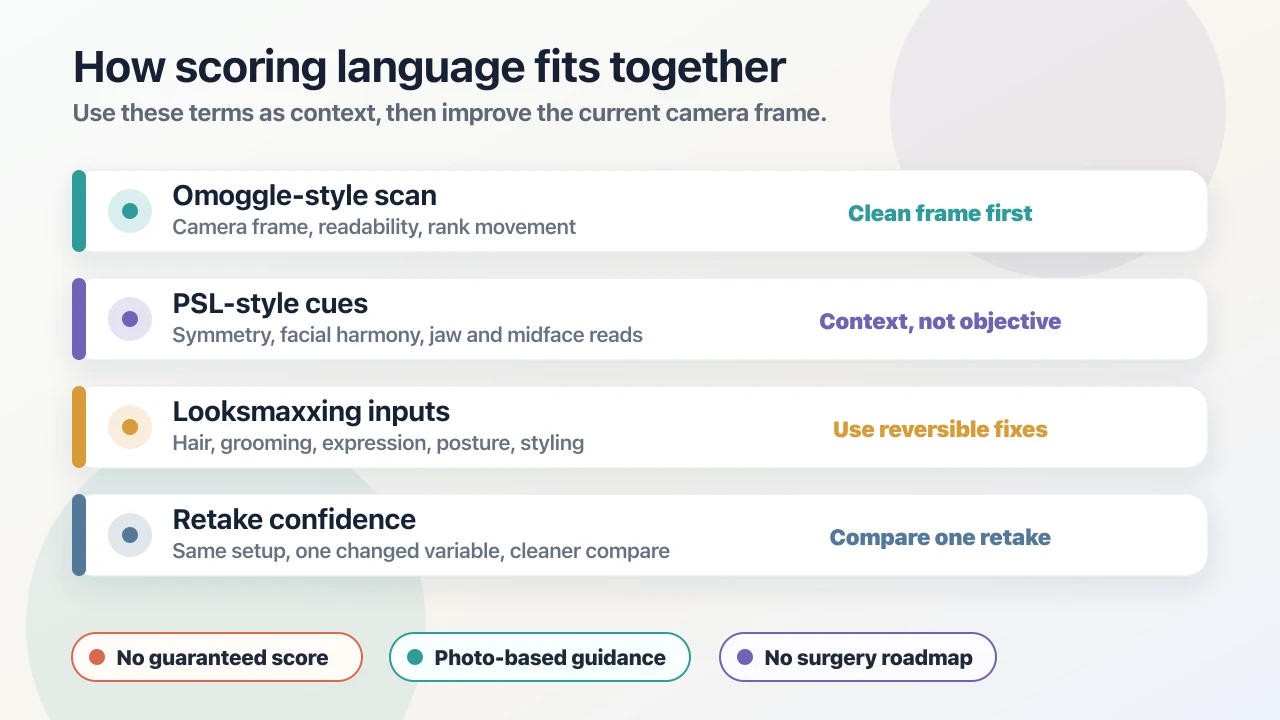 ExplainerPSL, Looksmaxxing, and Omoggle Scores ExplainedIdentify what a score measures, ask for its input and criteria, and turn a readable observation into one practical next-photo decision.